
Methodology
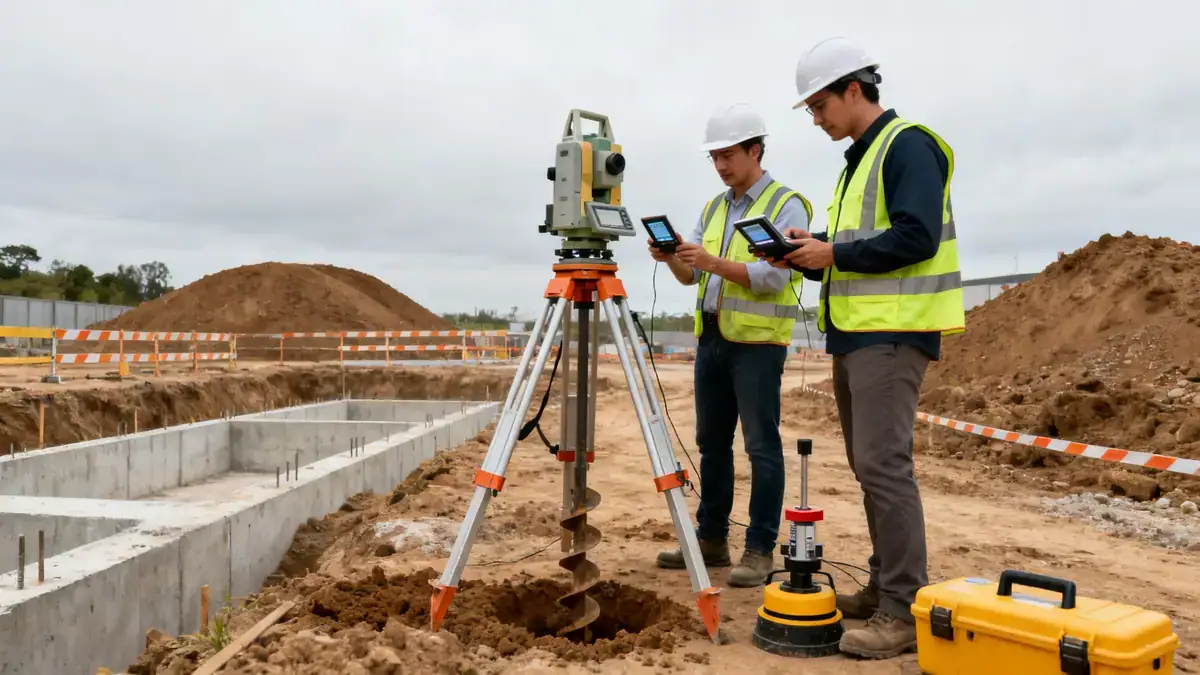
Our methodology for soil mechanics laboratory work in Bristol follows a systematic approach aligned with British Standards (BS 5930) and Eurocode 7. Field investigations include boreholes with standard penetration testing (SPT) per ASTM D1586, typically at 1.0–1.5 m intervals, reaching depths of 8–15 m for residential sites and up to 30 m for industrial projects. In-situ testing is complemented by laboratory analyses such as granulometry & atterberg to classify soils and assess plasticity. All procedures are executed under strict quality control to ensure repeatability and accuracy, supporting foundation design and earthworks specification.
Reference Technical Parameters
| Parameter | Reference Value |
|---|---|
| Predominant soil type | Alluvial clays, silts, and sands overlying Triassic mudstone and sandstone |
| Maximum seismic acceleration (PGA) | 0.10–0.15 g (UK National Annex to Eurocode 8) |
| Typical groundwater level | 1.5–4.0 m below ground surface (variable with season and location) |
| Bedrock depth | 10–30 m in valley bottoms; shallower (3–10 m) on higher ground |
| Typical N60 range (SPT) | 2–15 in alluvium; 20–50+ in weathered mudstone |
Local Considerations — Bristol
Bristol's geology is dominated by Quaternary alluvium in the Avon valley, underlain by Mercia Mudstone and Dolomitic Conglomerate. Ground conditions vary significantly between neighborhoods: central areas (e.g., City Centre, Harbourside) feature deep alluvial deposits with high plasticity and shallow groundwater, while eastern suburbs (e.g., St George, Kingswood) have shallower bedrock and firmer ground. Our team's experience with local soil behavior enables precise proctor & cbr testing for compaction control in fill materials. Seismic hazard is low to moderate per Eurocode 8, but liquefaction potential in loose saturated sands near the river warrants careful assessment. Typical projects include residential developments, commercial buildings, and infrastructure such as the Bristol Temple Meads redevelopment.
Request a Quote
Our team reviews your project and issues an initial report at no cost.
Or write us directly at [email protected]
Services in Bristol
Locations covered in Bristol
Applicable Standards
- BS 5930:2015 Code of practice for ground investigations
- Eurocode 7: Geotechnical design (BS EN 1997-1, 1997-2)
- ASTM D1586 Standard test method for SPT
- Eurocode 8: Design of structures for earthquake resistance (BS EN 1998-1, 1998-5)
- NHBC Standards 2025 (Chapter 4.1 – Foundations)
Frequently Asked Questions
What are the typical soil types encountered in Bristol?
Bristol's soils are predominantly alluvial clays, silts, and sands in the Avon valley, underlain by Triassic Mercia Mudstone and Dolomitic Conglomerate. Glacial deposits may be present in some areas. The variability requires site-specific ground investigation to characterize stratigraphy and engineering properties.
Is seismic design required for buildings in Bristol?
Yes, per Eurocode 8 and the UK National Annex, Bristol falls in seismic zone with peak ground acceleration (PGA) of 0.10–0.15 g. Seismic design is mandatory for certain structures (e.g., hospitals, schools, tall buildings). Geotechnical studies must assess liquefaction potential and site amplification effects.
Are soil mechanics laboratory tests mandatory for construction in Bristol?
While not always legally required, thorough soil testing is strongly recommended by the British Standards and NHBC for foundation design. Local planning authorities often require ground investigation reports for new developments, especially in areas with challenging ground conditions or high water table.