Methodology

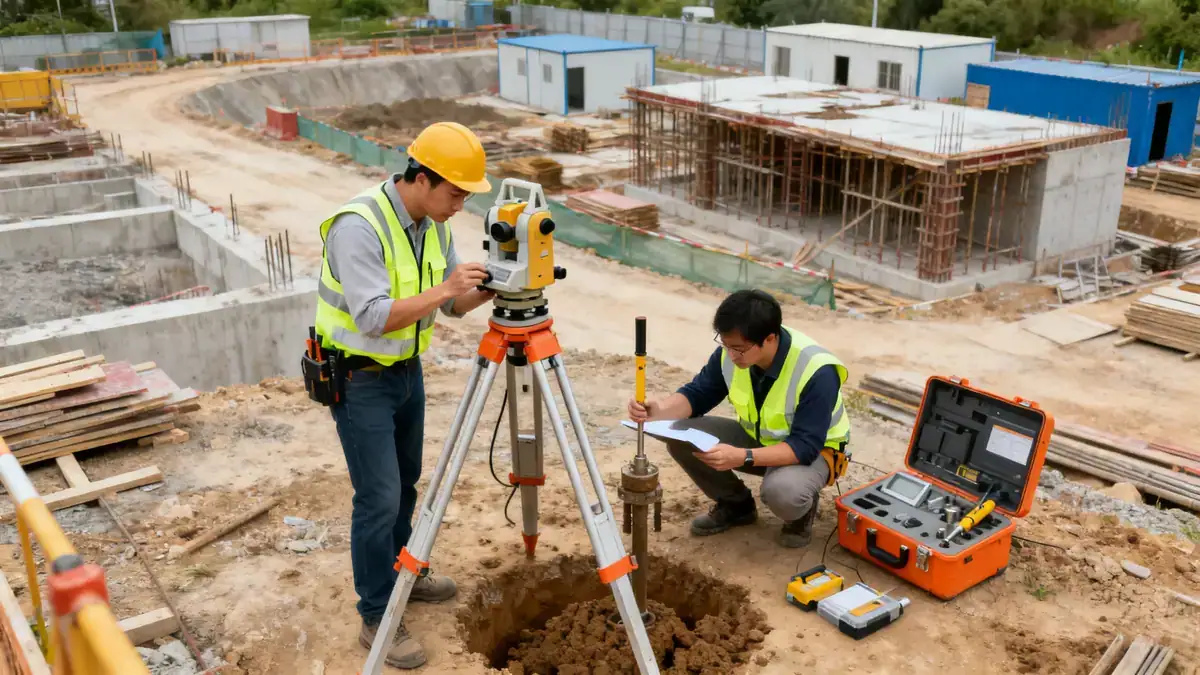
Our methodology for soil mechanics laboratory in Swindon integrates field sampling and advanced laboratory testing following BS 1377 and ASTM standards. We prioritize continuous sampling via SPT (ASTM D1586) at 1.0–1.5 m intervals to capture stratigraphic variations. For fine-grained soils, we conduct Atterberg limits and consolidation tests to assess shrink-swell potential, critical in Oxford Clay. Our team utilizes a phased approach: initial site reconnaissance, targeted borehole placement, and detailed laboratory analysis. This systematic process ensures that our soil mechanics laboratory services in Swindon deliver accurate parameters for foundation design, slope stability, and earthworks, tailored to local conditions.
Reference Technical Parameters
| Parameter | Reference Value |
|---|---|
| Predominant soil type | Oxford Clay, River Terrace deposits |
| Maximum seismic acceleration (PGA) | 0.05 g (low seismicity per UK National Annex) |
| Typical groundwater level | 2–5 m below ground surface (seasonal variation) |
| Bedrock depth | 30–50 m (Mudstone/Sandstone) |
| Typical N60 range (SPT) | 5–15 in clay, 20–40 in granular layers |
Local Considerations — Swindon
Swindon's geology is dominated by Oxford Clay, a highly plastic clay prone to shrinkage and swelling, requiring careful assessment of Atterberg limits and consolidation parameters. Groundwater levels fluctuate seasonally, often encountered at 2–5 m depth, affecting excavation and foundation design. Although seismicity is low (PGA 0.05 g), the UK National Annex to Eurocode 8 requires site classification for certain structures. The contrast between the historic town centre (shallow foundations) and modern industrial areas (deep piles) necessitates varied investigation depths. For a broader view, our soil mechanics laboratory en Bristol provides additional regional expertise.
Request a Quote
Our team reviews your project and issues an initial report at no cost.
Or write us directly at [email protected]
Services in Swindon
Applicable Standards
- Eurocode 7 (BS EN 1997)
- BS 1377 (Methods of test for soils for civil engineering purposes)
- ASTM D1586 (Standard Test Method for Standard Penetration Test)
- UK National Annex to Eurocode 8
Frequently Asked Questions
What are the typical soil types found in Swindon?
Swindon predominantly features Oxford Clay, a stiff to hard clay with high plasticity, along with River Terrace deposits of sand and gravel in the valleys. These soils require careful laboratory testing for properties like plasticity, compressibility, and shear strength.
Is seismic assessment required for construction in Swindon?
The UK has low seismicity, but Eurocode 8 and its UK National Annex require site classification for certain buildings (e.g., hospitals, tall structures). Swindon's PGA is 0.05 g, so seismic design is typically not critical, but ground type (A–E) must be determined via soil testing.
Are soil mechanics studies mandatory for building projects in Swindon?
While not legally mandatory for all projects, local planning authorities and building regulations (Approved Document A) recommend a geotechnical assessment for foundations. For complex sites or larger structures, a soil mechanics laboratory study is essential to ensure safety and avoid costly failures.