Methodology

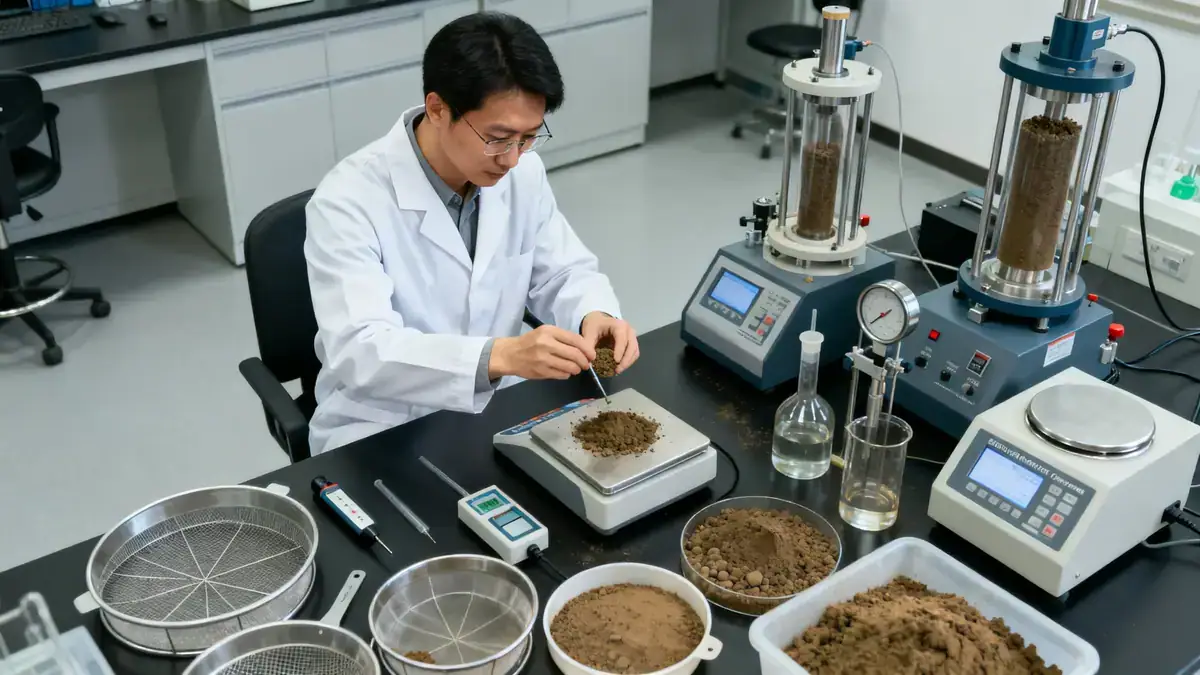
Our methodology for soil mechanics laboratory in Stoke On Trent follows a systematic approach combining field investigation and laboratory testing. We begin with a desk study of historical maps and borehole records to identify potential hazards. Standard penetration tests (SPT) per ASTM D1586 are conducted at 1.0–1.5 m intervals, reaching depths up to 15 m for residential structures. Samples are retrieved for classification, strength, and consolidation tests. Our soil mechanics laboratory procedures ensure compliance with UK standards, providing engineers with accurate parameters for foundation design.
Reference Technical Parameters
| Parameter | Reference Value |
|---|---|
| Predominant soil type | Glacial till (boulder clay) overlying Coal Measures sandstone and shale |
| Maximum seismic acceleration (PGA) | 0.05–0.10 g (low seismicity per BS EN 1998-1) |
| Typical groundwater level | 2.0–4.0 m below ground surface (variable with season) |
| Bedrock depth | 8.0–20.0 m (sandstone bedrock) |
| Typical N60 range | 10–30 blows/300 mm (in till); 40–60+ in dense sandstone |
Local Considerations — Stoke On Trent
Stoke On Trent's geology comprises glacial till overlying Coal Measures strata, with frequent sandstone and shale bands. Groundwater levels are generally shallow (2–4 m), requiring dewatering considerations for excavations. Seismic hazard is low (PGA < 0.10 g), but site-specific response may be needed for large structures. The city's mining legacy includes shallow coal workings and clay pits, which can cause differential settlement. Our team addresses these issues through targeted site investigations, integrating historical records and in-situ testing. For broader regional context, see soil mechanics laboratory en Manchester for similar industrial geology challenges.
Request a Quote
Our team reviews your project and issues an initial report at no cost.
Or write us directly at [email protected]
Services in Stoke On Trent
Applicable Standards
- ASTM D1586 (Standard Test Method for Standard Penetration Test)
- BS EN 1997-1 (Eurocode 7 – Geotechnical design)
- BS 5930 (Code of practice for ground investigations)
- BS EN 1998-1 (Eurocode 8 – Seismic design, UK National Annex)
Frequently Asked Questions
What types of soil are typically found in Stoke On Trent?
The predominant soil is glacial till (boulder clay), which is a stiff, cohesive material with variable cobble content. Underlying bedrock consists of Coal Measures sandstone and shale. Alluvial deposits may be present in valley bottoms.
What seismic design requirements apply in Stoke On Trent?
Stoke On Trent is in a low seismicity region per BS EN 1998-1. The UK National Annex assigns a peak ground acceleration (PGA) of 0.05–0.10 g for the area, though site-specific response spectra may be needed for critical structures.
Are soil investigations mandatory for construction in Stoke On Trent?
While not legally mandatory for all projects, BS 5930 recommends ground investigations for any significant structure. Local planning authorities often require geotechnical reports for developments on brownfield sites or areas with mining legacy.